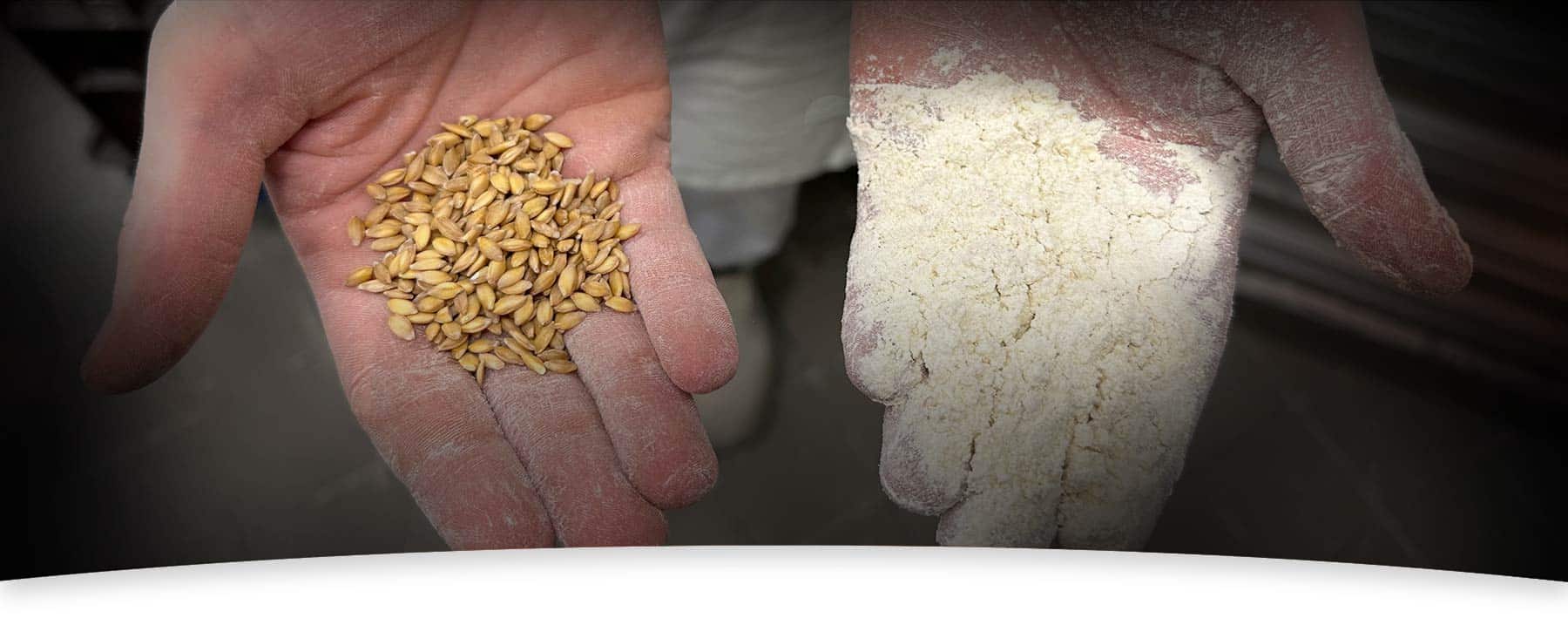
FROM EINKORN FLOUR TO EINKORN BREAD
EINKORN
Einkorn (Triticum monococcum), also known as ‘littlespelt’, was already being gathered and eaten by hunter-gatherers 30,000 years ago. It is the earliest grain cultivated by humans (8000 BC), even before oats and emmer. Nowadays, einkorn is rarely cultivated.
Einkorn has a very low yield, because each spikelet contains only one grain. That grain is fused with the husk, a hard and sharp shell that surrounds the grain. This has advantages: the grains are well protected against cold and moisture, heat and pollution, diseases and fungi.
However, the process of removing the husk (husking) is difficult and labour-intensive. This husking, combined with the low yield, makes it an expensive grain.
The plant does not tolerate any human intervention: pesticides are not necessary because the plant protects itself well against disease. The plant does not tolerate fertiliser or extra water because it prefers to grow in poor, dry soil.
Einkorn is rich in magnesium, phosphorus and calcium. It is one of the rare grains, along with quinoa and amaranth, that contains eight essential fatty acids. Einkorn is low in gluten, which makes it difficult to use for making bread.

MY EINKORN BREAD
EINKORN BREAD IN MY SHOPS AND WEBSHOP:
This is the French word for einkorn. Einkorn is also known as ‘petite épeautre’ (small spelt) in French. I don’t use that term, as it causes confusion with spelt.
My einkorn bread is a wholemeal bread made from freshly ground einkorn flour.

Olympiaplein 119
1077 CW Amsterdam
Tel.: 020-6724211
Open from Monday to Saturday:
7 am to 7 pm.
Gijsbr. van Amstelstraat 131
1214 AW Hilversum
Tel.: 035-6210602
Open from Monday to Saturday:
7 am to 7 pm.
Amsterdamseweg 189
1182 GV Amstelveen
Tel.: 020-8232412
Open from Monday to Saturday:
7.30 am to 7pm.